I feel a quiet anxiety right now that has nothing to do with geopolitics or the economy.
It’s the sense that the ground is shifting. That the skills, instincts, and positioning that got me here may not be what carries me forward. That I’m watching something unfold and don’t yet know where I fit.
If this feels familiar, it’s because you’re paying attention.
I have felt it before.
In 2016, something was happening in crypto that went beyond just speculation. I felt a shift before I could name what was moving. Reddit threads were going deep. Not just price talk, but philosophy, game theory, arguments about what money even was. Meetups were multiplying. People who had nothing obvious in common were showing up in basements and co-working spaces to debate systems that hadn’t yet solidified into anything people agreed was real.
I was drawn in, not because I understood it, but because the energy was unmistakable. It felt like early internet forums, but with stakes. Something was being built, and the people building it were treating it like it mattered.
And then, in August of that year, I walked into a meetup in Berlin — “Mamoru & The Big ETH-ETC Debate.” The DAO had just been hacked. The community had just split over whether to rewrite history. Two chains now existed — ETH, which rolled back the hack, and ETC, which refused to.
Christoph Jentzsch, who had built The DAO, was there. So were researchers, developers, and people I didn’t recognize who would later become influential voices in the space. The room wasn’t debating facts. Everyone knew what had happened. They were debating what it meant.
One side said: the code is law. The hack was technically valid. Rolling it back would destroy the credibility of immutable systems forever.
The other said: intent matters. Letting a thief walk away with $60 million because of a technicality would destroy the credibility of the community forever.
Same information. Opposite conclusions. No authority to settle it.
I came in thinking this was about technology. I left understanding it was about sense-making — about who gets to interpret events when authority disappears.
That was ten years ago. I’ve thought about it ever since — and I’m feeling something similar now.
Moments like that don’t announce themselves as revolutions. They feel like confusion. Disagreement without resolution, intensity without clarity.
What’s actually happening is quieter. A system has begun to outgrow the frameworks we use to understand it. Meaning fragments before it reorganizes.
Only later do we recognize these moments for what they were.
Here’s the thing: Every major revolution creates an abundance that didn’t exist before.
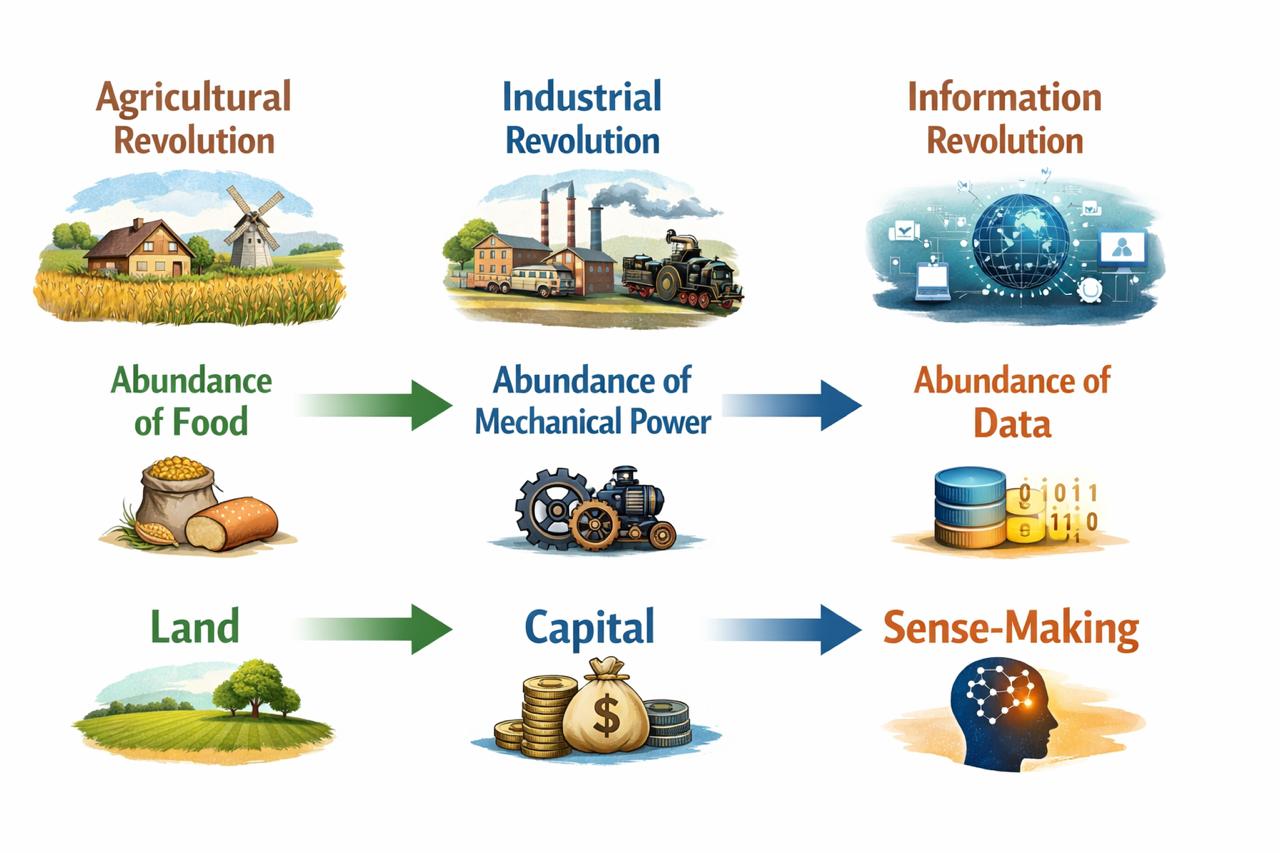
The Agricultural Revolution created an abundance of food. For the first time, humans could produce more calories than they needed to survive. The implications were not clear early on and took millennia to unfold. Those who learned how to store grain, manage land, and organize labor accumulated durable advantage. Land became the primary asset. Control over surplus determined who thrived.
The Industrial Revolution created an abundance of mechanical power. Goods and people could move further, faster, and cheaper than ever before. The implications were clear early on and took centuries to unfold. Factories, railways, and ships required large upfront investment before value could be produced. Those who could accumulate capital, finance infrastructure, and absorb risk gained lasting advantage. Capital became the primary asset. Power flowed to those who could coordinate machines, labor, and time at scale.
Now we’re in the Information Revolution. We’re experiencing an abundance of data so vast it doesn’t feel like abundance. It feels like overwhelm. For the first time, humans can generate, copy, and transmit information at a scale far beyond their capacity to absorb it. The implications are stark and are unfolding in decades, maybe years. Data has become cheap, ubiquitous, and overwhelming. The constraint is no longer access, storage, or speed but interpretation. Those who can filter noise, recognize patterns, and orient themselves amid uncertainty gain durable advantage. Sense-making is now the primary asset. Power flows to those who can decide what matters when everything is available.
AI is not the revolution. AI is what makes the revolution navigable.
Just as the plough made land the decisive asset.
Just as the steam engine made capital decisive.
AI is the sense-making layer for the information age.
Those who fear it — who wait for it to go away, or for the government to regulate it into safety — will be positioned by those who didn’t wait.
The fear is understandable. AI operates in the domain we thought was ours alone. Language, reasoning, creativity. It’s unsettling to watch a machine do something you believed required a human.
But the fear is misplaced. We’ve seen it before.
The printing press didn’t replace thinkers. It multiplied them.
The calculator didn’t replace mathematicians. It freed them.
AI won’t replace sense-makers. It will extend what they can see.
Those who learn to master it will compress years of pattern recognition into weeks.
And mastery is the key.
What matters now isn’t access to AI. Access will be universal.
What matters is the relationship you build with it.
Most will use AI the way they use every other platform; episodically, transactionally, inside someone else’s system. Helpful, powerful, but ultimately opaque. A tool that answers questions without ever becoming part of how they think.
Mastery looks different.
The approach I’ve been exploring with George treats AI not as a service to query, but as a long-running thinking partner. One that accumulates context, challenges assumptions, and sharpens judgment over time. To master AI is not to delegate judgment to it, but to train alongside it. To develop a system that reflects your context, remembers your questions, and evolves with your goals.
This is why ownership matters. When an AI lives entirely inside someone else’s ecosystem, you don’t build understanding, you rent it. Your context feeds their infrastructure. Your thinking sharpens their model. The relationship ends where their incentives do.
The alternative is quieter, but more durable. Systems you can inspect. Modify. Carry with you. AI that becomes part of your thinking practice rather than a layer you pass through.
Every revolution eventually rewards those who move beyond use and toward mastery. Not prediction. Not resistance. Participation with intent.
The question isn’t whether AI will shape the next era. It already is.
The question is whether you’ll use it or master it.